Author: Keith Verner

  • Why Some EOS Companies Scale & Others Stall

    Oxano Field Notes — Issue #10
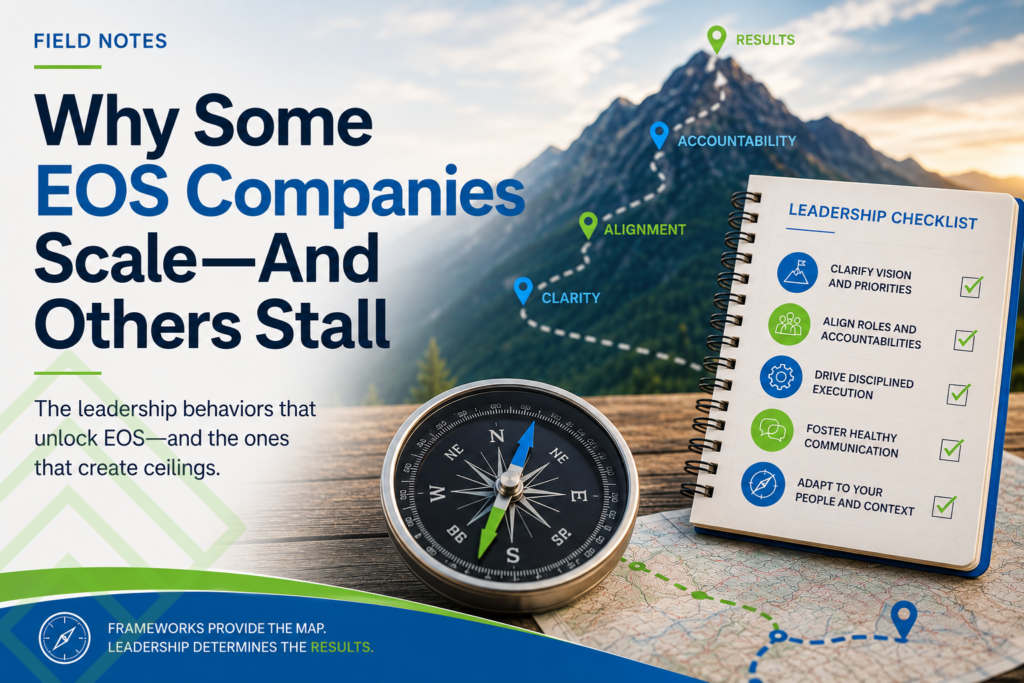

    I frequently encounter the Entrepreneurial Operating System (EOS) within the companies I advise and in many of the leadership opportunities I evaluate. Over time, I have noticed that some organizations implement EOS and quickly gain the clarity, accountability, and alignment they were hoping for. Others adopt the same tools, embrace the same terminology, and still struggle with growth ceilings, recurring turnover, and decision-making bottlenecks.

    In my experience, the difference lies outside the framework itself.

    Most enduring management systems are built on remarkably similar principles. Whether we are talking about EOS, Lean, Six Sigma, OKRs, or a company’s own mission, vision, and values, the underlying themes tend to address clear priorities, defined accountability, structured communication, disciplined execution, and a commitment to continuous improvement. These systems are valuable because they provide a common language and a repeatable structure for turning strategic intent into coordinated action. At the same time, no framework is universally applicable in exactly the same way.

    Every organization is a living system made up of people. Even two companies offering nearly identical services to similar customers will differ in meaningful ways. Their leadership styles, histories, personalities, incentives, and cultural norms will never be perfectly alike. Sometimes those differences are subtle, and sometimes they are profound. In either case, they shape how decisions are made, how conflict is handled, and how accountability is experienced throughout the organization. That is why no operating system should be applied mechanically.

    A framework can provide structure, but structure alone does not create results. Leaders still need to exercise judgment. They need to understand the unique dynamics of their team, the stage of the business, and the behaviors they are trying to encourage. Used thoughtfully, a management system amplifies what is already healthy. Applied rigidly, it can formalize the very dysfunctions it was intended to solve. EOS is no exception.

    At its best, EOS creates clarity around roles, priorities, and decision rights. It helps leadership teams surface issues, solve problems, and stay aligned around a shared vision. At its worst, it becomes another set of labels and meeting rhythms layered over unresolved leadership issues. A weekly Level 10 Meeting does not create accountability on its own. An accountability chart does not automatically clarify authority. And calling someone a Visionary does not make them humble, strategic, or open to better ideas. This last point is worth exploring because it highlights both the strength and the potential pitfall of the EOS model.

    The Visionary and Integrator partnership can be incredibly powerful when both roles are understood as responsibilities rather than identities. In healthy organizations, the Visionary focuses on long-term direction, major relationships, and emerging opportunities. The Integrator translates that direction into coordinated execution across people, systems, and priorities. Together, they create a productive tension between possibility and discipline. Problems can arise when role definitions evolve into personal identities.

    If “Visionary” becomes a badge of status rather than a description of where someone adds the most value, the organization can begin to operate as though one person is the primary source of insight while everyone else is expected to execute. Over time, that dynamic will discourage constructive challenge, and turn the Integrator into a coordinator rather than a true operational partner.

    The strongest founders I have worked with are unquestionably visionary, but they wear the label lightly.

    They understand that great ideas can come from anywhere in the organization. They recognize that leadership is a responsibility rather than a title, and they welcome thoughtful pushback because they know it improves decision-making. Their confidence is grounded in conviction, but it is balanced by humility. Not surprisingly, organizations led by founders with that mindset tend to use EOS very effectively.

    These companies treat EOS as a framework rather than a doctrine. They adapt the tools to fit the realities of the business instead of forcing the business to fit the tools. Titles clarify accountability rather than establish hierarchy. Healthy debate and candor are expected. The Integrator has real authority to make decisions and resolve issues. And the founder is held accountable to the same standards as every other member of the leadership team. When those conditions are absent, the same framework often produces very different results.

    In organizations that continue to struggle despite implementing EOS, a few recurring themes tend to emerge. The founder remains the primary decision-making bottleneck. EOS terminology is adopted, but underlying behaviors remain unchanged. Dissent is limited, often unintentionally. The Integrator lacks meaningful authority and talented leaders eventually disengage when accountability is uneven or their influence is constrained. Worse yet, they’ll recognize these shortcomings in your talent search and never accept the opportunity.

    A Practical Guide: Signs EOS Is Working as Intended

    For leaders evaluating their own organization—or operators considering a new opportunity—the following checklist can serve as a quick diagnostic.

    Indicators That EOS Is Working Well

    • The founder welcomes constructive challenge.
    • Strategic ideas regularly emerge from across the organization.
    • The Integrator has meaningful decision-making authority, along with others on the leadership team.
    • Accountability applies equally to every member of the leadership team.
    • EOS tools are adapted thoughtfully to fit the business.
    • Healthy debate and candor leads to better decisions.
    • Leadership turnover is low and high performers remain engaged.

    Indicators That EOS May Be Reinforcing Existing Constraints

    • Major decisions continue to funnel through the founder.
    • EOS terminology is used, but behaviors have not materially changed.
    • Team members are hesitant to disagree.
    • The Integrator functions primarily as a coordinator or general manager.
    • Accountability is inconsistent.
    • Turnover remains elevated.
    • The organization feels dependent on one person for direction.

    This is not a scorecard to pass or fail. Rather, it is a practical way to assess whether the framework is helping the organization become healthier and more scalable.

    When I am evaluating an EOS-driven organization, I am therefore less interested in whether they use the framework and more interested in how leadership behaves within it.

    A few questions are especially revealing

    If you are evaluating an EOS-driven organization, these are the questions I would keep close at hand:

    1. Where do you believe your greatest strengths as a leader lie?
    2. What aspects of leadership are you intentionally working to improve?
    3. How are ideas surfaced and evaluated within the organization?
    4. Can you share an example of a significant strategic decision that originated from someone other than you?
    5. What decisions are fully owned by the Integrator without your approval?
    6. How do you ensure you are held accountable to the same standards as the rest of the leadership team?
    7. What would your leadership team say is the most important thing an Integrator needs to do to be successful with you?

    Taken together, these questions provide a clearer picture of the leadership environment than any discussion of tools, terminology, or process maps.

    Healthy founders speak comfortably about feedback, growth, and being challenged by others. They tend to say things like, “My team challenges me regularly,” or, “Many of our best ideas come from others.” They are candid about what they are still learning and where they need help.

    By contrast, caution is warranted when every major decision ultimately flows through one person, when disagreement is rare, or when the Integrator’s role is described primarily as ensuring that everyone aligns with what the founder wants. To be clear, none of this is a critique of EOS.

    EOS can be an exceptional operating framework. It’s one of my favorites. But like any management system, it can only reinforce the leadership behaviors already present within the organization. It cannot create humility, trust, or accountability where those qualities do not exist.

    Frameworks do not create healthy organizations, leaders do.

    The most effective leaders use systems to distribute ownership, sharpen accountability, and elevate the contributions of others. They understand that every organization is unique and that no framework can replace thoughtful leadership. When applied with humility and sound judgment, EOS helps organizations become stronger than any one individual, which is ultimately the point.

  • When Culture Isn’t Explicitly Designed to Scale, It’s Implicitly Left to Chance

    Oxano Field Notes — Issue #9

    A framework for MVV design and integration (free download)


    Confident female manager wearing glasses listening carefully in team meeting

    When an organization is small in number, culture exists in proximity. It shows up in how decisions are made, how pressure is handled, who is trusted, and what is tolerated. Teams don’t need it written down because they experience it directly. They watch how leaders operate and absorb it through repetition.

    The challenge is that proximity doesn’t scale, and even if it could, it wouldn’t be enough on its own. Organizations are not static, people move on. Some leave for new opportunities, some step away over time, and others simply reach a point where they can no longer carry the same level of influence as the business grows. Even in strong, healthy cultures, turnover is a constant. And what was once learned through observation is no longer consistently present to be observed.

    Without intention, culture doesn’t just become inconsistent, it begins to drift. And that drift is rarely neutral. In the absence of clarity, people fill in the gaps based on their own experiences, preferences, and assumptions about what success looks like. Over time, those interpretations compound, and what once felt like a shared way of operating becomes a collection of slightly different versions of it.

    This is where the idea that “those who fail to plan, plan to fail” becomes more than a cliché. If culture is not explicitly designed to scale, it is implicitly left to chance. And chance, especially across a growing organization with changing people and increasing complexity, does not produce consistency.

    This is usually where organizations try to formalize what had previously been informal. Mission, Vision, and Values are written or revisited, often with the goal of preserving what made the company work in the first place. The intent is right, but the execution often falls short because these frameworks are written to inspire rather than to guide. A mission statement defines purpose. A vision paints a future. Values are reduced to words that everyone agrees with but few can apply with precision.

    The issue is not that Mission, Vision, and Values are unnecessary. It’s that they are rarely developed with enough depth to carry the weight they are expected to hold. Culture is not tested in alignment around a statement, it is tested in the decisions that follow. That includes the obvious strategic choices around where to invest, how to grow, and what to prioritize, but it also includes the smaller, more frequent decisions that shape how the business operates day to day. How tradeoffs are handled when time is constrained, how standards are applied when no one is watching, how teams respond when something breaks, these are the moments where culture becomes real.

    If Mission, Vision, and Values cannot guide both ends of that spectrum, they leave too much open to interpretation. And interpretation, while unavoidable to some degree, is where variability enters the system. Over time, that variability compounds. Teams begin to operate with slight differences in standards and expectations. Leaders find themselves revisiting decisions that should already be clear. Performance becomes less predictable, not because the team lacks capability, but because the underlying guidance is not consistent enough to support them.

    Some organizations recognize this gap and attempt to solve it by introducing guiding principles. In many cases, this is a thoughtful step. Guiding principles tend to bring specificity to how decisions should be made. They translate abstract values into directional statements that hold up under pressure, clarifying not just what the organization believes, but how it behaves when faced with tradeoffs. That added resolution can be useful, particularly in more complex or rapidly scaling environments.

    At the same time, introducing another layer raises an important question. Are guiding principles expanding clarity, or are they compensating for values that were never fully defined? If values remain high-level while principles carry the real operational weight, the organization effectively splits its source of truth. Over time, that can create its own form of inconsistency, where different parts of the organization anchor to different layers.

    There is a strong case for discipline here. When Mission, Vision, and Values are built with enough detail, they can stand on their own. Values, in particular, should function as decision filters, not just statements of belief. That requires more than naming what matters. It requires defining what those values look like in practice, where they take priority, and what tradeoffs they imply. It means being explicit about what is acceptable and what is not, even when those distinctions are uncomfortable. When done well, the nuance that might otherwise live in guiding principles is embedded directly into the values themselves.

    That said, there are environments where an additional layer is useful. Organizations operating across multiple functions, navigating rapid change, or building new leadership layers quickly may benefit from the added clarity that guiding principles provide. In those cases, the role of principles is not to replace values, but to extend them in ways that remain consistent with the original intent.

    Whether you choose to operate with MVV alone or include guiding principles, the standard is the same. Your culture framework should be able to do three things:

    1. Drive Consistent Decisions Without Leadership Present
      If a team cannot use it to make a hard call, it is incomplete.
    2. Create Alignment Across Functions
      Sales, operations, finance, and technology should interpret it the same way under pressure.
    3. Hold the Organization Accountable
      It should be clear when someone is operating in alignment and when they are not.

    Regardless of structure, the standard is the same. A culture framework should enable consistent decision making without requiring constant leadership involvement. It should create alignment across functions, even when those functions are operating under different pressures. And it should provide a clear basis for accountability, making it evident when actions are aligned with the organization’s expectations and when they are not.

    When those conditions are met, culture begins to scale with far less friction. Decisions happen closer to where the work is being done. Teams move with more confidence and less rework. Leadership spends less time clarifying and more time advancing. What was once dependent on proximity becomes embedded in the way the organization operates.

    At that point, culture is no longer something that needs to be reinforced through reminders or corrected through intervention. It becomes a system that carries itself forward, shaping decisions at every level with a level of consistency that would be difficult to achieve otherwise.

    And that is the real objective. Not better statements, but better decisions at scale.

    Closing Thoughts

    If you’re finding culture is becoming harder to explain, harder to maintain, or more dependent on who’s in the room, that’s usually a signal that it hasn’t yet been defined with enough clarity to scale.

    If you haven’t worked through it in a structured way, this downloadable MVV framework can be a practical place to start. Or, better yet, schedule a discussion to see if an engagement with our team is the right solution for your organization.

    Related Consulting Services

  • Building an AI-Enabled Competitive Advantage

    Oxano Field Notes — Issue #8

    A guide for SMB teams ready to work smarter, move faster, and scale intentionally


    The Opportunity in Front of You

    meaningful shift in how work can be designed, executed, and improved over time. For growing organizations, this moment is less about technology adoption and more about operational clarity.

    What becomes possible is straightforward but powerful: work can move with less friction, decisions can happen closer to the moment they are needed, and teams can spend more of their time on high-impact contributions rather than coordination and repetition. AI, when applied thoughtfully, enables this shift, but does not create it on its own.

    The organizations that will realize the greatest return are those that begin with intention, not just another tool. They’ll take the opportunity to step back and ask a more foundational question: If we were designing how this work happens today, how would we build it?

    Understanding How Work Moves Through Your Business

    Every organization operates through a series of workflows, whether formally defined or not. A workflow is simply the set of steps required to complete a task from initial input to final outcome. These workflows often develop over time, shaped by growth, new systems, additional people, and well-intentioned process layers.

    Alongside workflows sit roles, which define how individuals contribute to moving that work forward. Over time, roles can become tightly bound to specific steps, approvals, or systems, even when those structures are no longer necessary.

    Artificial intelligence introduces a new dynamic into this environment. At its core, AI functions as an assistant that can process information quickly, generate outputs, and support decision-making. However, its effectiveness is directly tied to the clarity of the system it operates within. When workflows are clear and purposeful, AI accelerates them. When they are not, it simply moves complexity faster. This is why the starting point is not the technology itself, but the design of the work.

    From Adding Tools to Designing Better Work

    Many organizations approach AI by asking where it can be inserted into existing processes. While this can yield incremental improvements, it rarely leads to meaningful operational change.

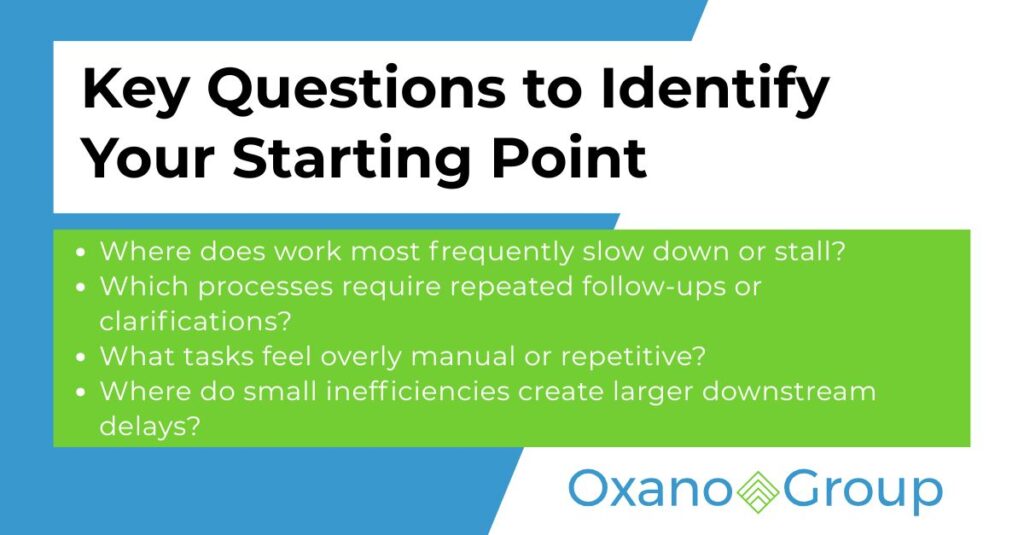
    A more effective approach begins with reimagining the workflow itself. Instead of asking where AI fits, high-performing teams will ask what the work should look like in its simplest, most effective form. They consider what steps are truly necessary, where decisions should be made, and how information should flow.

    From there, AI is applied with purpose to accelerate, support, or fully handle specific parts of that redesigned workflow. This shift, from layering tools onto existing systems to intentionally designing better ones, marks the difference between isolated gains and a sustained competitive advantage over those slower to adopt.

    Where to Begin: Identifying High-Value Workflows

    Every organization has a small number of workflows that carry disproportionate importance. These are often tied to customer experience, revenue generation, or internal coordination that impacts multiple teams. They are also the areas where delays, rework, or ambiguity tend to surface most clearly.

    Focusing on these workflows first creates immediate clarity and momentum. Rather than attempting to improve everything at once, narrowing attention to a few critical flows allows teams to see tangible progress and build confidence in a new way of operating.

    Designing Workflows That Move with Clarity

    Once a priority workflow is identified, the next step is to redesign it with simplicity in mind. This is not about incremental improvement, it’s about removing friction and creating a clean, intentional flow of work.

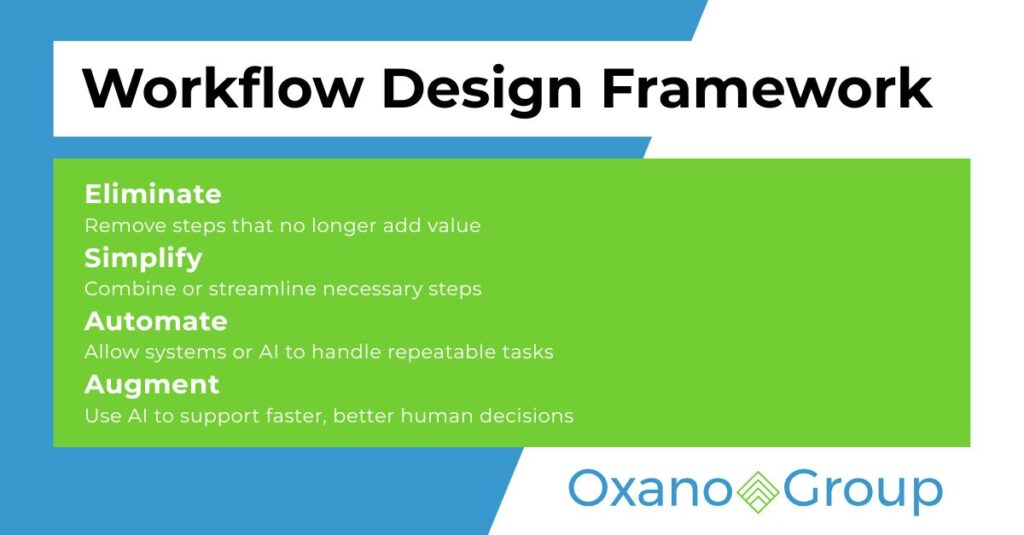
    A practical way to approach this is through four actions:

    When applied thoughtfully, this approach reduces complexity without sacrificing quality. In many cases, it reveals that what once required multiple handoffs can be completed by a single accountable owner, supported by the right tools.

    Aligning Roles in an AI-Enabled Environment

    As workflows become more streamlined, roles naturally evolve alongside them. This is not about reducing the importance of people, it is about allowing individuals to focus on the work where they create the most value. And value creation positively impacts culture in any environment.

    A helpful way to think about this shift is to distinguish between three types of work. Some activities remain deeply human, requiring judgment, relationship-building, and leadership. Others benefit from AI assistance, where speed and clarity can be enhanced without removing human oversight. Still others can be fully automated, particularly when they are repetitive and rules-based.

    When these distinctions are made clear, teams operate with greater focus. Individuals spend less time navigating process and more time contributing meaningfully to outcomes. AI becomes a support system within a well-defined structure, rather than a disruptive force layered on top.

    AI That Reflects Who You Are

    There is a deeper layer to this conversation that often gets overlooked. As organizations adopt AI, the question is not only how work becomes faster or more efficient. It is whether the way that work is done continues to reflect what the organization stands for.

    Every company operates from a set of beliefs, whether formally defined or not. Mission defines why the organization exists. Vision points to where it is going. Values shape how decisions are made along the way. These are not abstract ideas – they are the standards that guide behavior, prioritization, and ultimately, outcomes.

    AI will participate in that system. The way it is implemented will influence how decisions are made, how customers are engaged, and how teams experience their work. Without intentional alignment, organizations risk introducing speed and scale that unintentionally drift from their identity.

    With alignment, something very different happens. AI becomes an extension of the organization’s principles. It reinforces how decisions are made, supports the kind of customer experience the company is known for, and helps teams operate in a way that is consistent with the culture they are building.

    This is where discipline matters. Before implementing AI within a workflow, it is worth asking a different set of questions:

    • Does this change or reinforce how we want to show up for our customers?
    • Does it support the level of quality and care we expect in our work?
    • Does it enable our team to operate in a way that reflects our values?

    When these questions guide implementation, AI does more than improve efficiency, it strengthens the integrity of the organization as it scales.

    Building a Secure and Accountable AI Strategy

    From a VCIO or Director of IT perspective, successful AI adoption is not about chasing tools. Instead, it’s about creating a secure, practical, and accountable way to enhance business operations. The true opportunity arises when leaders identify areas where AI can streamline manual tasks, accelerate processes, and support more informed decision making. At the same time, they must implement robust guardrails to safeguard data, ensure access controls, and maintain oversight.

    Organizations that excel in this approach are not merely experimenting with AI; they are constructing a more robust operating model that is scalable, governed effectively, and aligned with business objectives.

    Creating Momentum Through a Consistent Rhythm

    Sustainable progress does not require large-scale transformation initiatives. It is built through consistent attention, iteration, and alignment with the principles that guide the organization  its Mission, Vision, and Values.

    These are not static statements. They act as a filter for how work is designed, how decisions are made, and how new capabilities like AI are introduced into the business.

    Establishing a simple operating rhythm allows teams to continuously refine how work gets done. At the team level, this means regularly reflecting on what slowed progress and where improvements can be made. At the leadership level, it involves stepping back to assess which changes are delivering value and where to focus next.

    This rhythm creates a compounding effect. Small improvements, implemented consistently, lead to meaningful gains over time. As confidence grows, so does the organization’s ability to take on more ambitious redesigns.

    Building Confidence and Adoption

    Adoption of new ways of working is strongest when it is grounded in clarity and shared purpose. Teams respond well when they can see how changes make their work more effective and less burdensome.

    Starting with visible, practical improvements helps build that confidence. When individuals experience firsthand how a redesigned workflow or AI-assisted step saves time or reduces frustration, momentum follows naturally. Open dialogue, feedback, and iteration further strengthen this process, ensuring that improvements are both effective and sustainable.

    What This Unlocks

    When workflows are intentionally designed and roles are clearly aligned, AI becomes a true multiplier. Work progresses with fewer interruptions, decisions are made more efficiently, and teams can focus on the areas where they have the greatest impact.

    Over time, this creates a system that not only performs better but continues to improve. Each refinement builds on the last, resulting in an operating model that is both scalable and resilient.

    Moving Forward

    The path forward does not require sweeping change. It begins with a single workflow, thoughtfully examined and redesigned. From there, progress builds step by step.

    Organizations that take this approach position themselves to move with clarity and confidence, making the most of what AI enables without losing sight of what matters most: how work gets done, and how people contribute to it.

    Final Thought

    AI offers a powerful opportunity, but its true value is not found in the technology itself. It is found in how thoughtfully it is integrated into the way an organization operates, and how consistently that integration reflects what the organization stands for.

    When work is clear, teams are aligned, and decisions are guided by a strong Mission, Vision, and Values, AI becomes more than a tool. It becomes a natural extension of how the business thinks, operates, and grows.

    That is what allows organizations to scale without losing what made them effective in the first place. And that is where lasting advantage is built.

    Related Consulting Services

  • Where Clarity Usually Pays Off First

    Oxano Field Notes — Issue #5

    When leaders sense operational friction, the instinct can be to look for large structural changes. But in many organizations, the most immediate improvements come from examining a few areas that quietly shape both the company’s culture and its financial performance. Not because they are dramatic, but because they are often overlooked.

    Over time, I’ve noticed that three operational areas consistently reveal meaningful opportunities for improvement when leadership teams take the time to examine them closely. At Oxano Group, we refer to these as the three operational lenses—places where clarity frequently reveals both hidden strength and unexpected opportunity.

    The Benefits Lens

    Vendor relationships tend to remain in place far longer than leadership teams realize. Benefits providers, brokers, and service partners often renew contracts year after year with little scrutiny while costs gradually rise. Service levels slowly drift. Alignment between the vendor’s incentives and the company’s needs becomes less clear.

    In many cases, this happens simply because these relationships were once working well. Over time, they become part of the background of the organization. But when leadership teams step back and review these relationships intentionally, they often discover opportunities to strengthen alignment, improve cost structure, or clarify expectations. Sometimes the result is renegotiation or finding someone better aligned with your stage of growth. Other times it is simply a clearer understanding of the arrangement.

    Either way, clarity tends to strengthen relationships and the organization’s confidence in them.

    The Systems Lens

    Technology is meant to accelerate execution, but software stacks rarely evolve with the same discipline that organizations apply to other parts of the business. A tool is added to solve a problem for one team. Another platform helps automate a process somewhere else. Over time, licenses accumulate and systems grow more complex than anyone originally intended.

    Eventually organizations find themselves slaves to the technology instead of being supported by it. Teams spend unnecessary time moving information between systems, maintaining redundant tools, or navigating poorly integrated platforms.

    When leadership teams pause to evaluate the structure of their technology environment, the goal is frequently cost reduction. The more meaningful outcome, however, is operational clarity—ensuring that the systems supporting the business actually help teams move faster and work more effectively together.

    The Financial Lens

    Modernized organizations produce more financial data than ever before. But clarity does not come from volume. Leadership teams can find themselves navigating reports that focus heavily on historical activity while providing little insight into the signals that guide future decisions. Key performance indicators sometimes measure effort rather than outcomes, and margin drivers remain harder to see than they should be.

    When financial visibility improves, leadership conversations begin to change. Decisions become faster because the information guiding them is more focused and clear. Priorities become sharper because the metrics truly reflect how the business performs and shifting trends.

    Financial clarity does more than strengthen financial management, it strengthens leadership confidence and competitive advantage.

    Why These Areas Matter

    What makes these three lenses particularly powerful is that they influence two outcomes every healthy organization cares about, financial performance and company culture.

    When systems are unclear, people feel it in their day-to-day work. When leadership lacks visibility, teams feel the uncertainty that follows. And when vendors, tools, or reporting structures quietly work against the organization’s mission, the effects show up both on the balance sheet and in the way the organization operates.

    Editor’s Note

    At Oxano Group, Operational Diagnostics are designed to help leadership teams see their organization clearly. Sometimes a comprehensive operational review is required, but more often by examining a specific pressure point.

    The most productive starting point is simply looking through one of these three lenses: the Benefits Lens Review, the Systems Lens Review, or the Financial Lens Review.

    You can learn more about our Operational Diagnostics here.