
Oxano Field Notes — Issue #8
A guide for SMB teams ready to work smarter, move faster, and scale intentionally
The Opportunity in Front of You
meaningful shift in how work can be designed, executed, and improved over time. For growing organizations, this moment is less about technology adoption and more about operational clarity.
What becomes possible is straightforward but powerful: work can move with less friction, decisions can happen closer to the moment they are needed, and teams can spend more of their time on high-impact contributions rather than coordination and repetition. AI, when applied thoughtfully, enables this shift, but does not create it on its own.
The organizations that will realize the greatest return are those that begin with intention, not just another tool. They’ll take the opportunity to step back and ask a more foundational question: If we were designing how this work happens today, how would we build it?
Understanding How Work Moves Through Your Business
Every organization operates through a series of workflows, whether formally defined or not. A workflow is simply the set of steps required to complete a task from initial input to final outcome. These workflows often develop over time, shaped by growth, new systems, additional people, and well-intentioned process layers.
Alongside workflows sit roles, which define how individuals contribute to moving that work forward. Over time, roles can become tightly bound to specific steps, approvals, or systems, even when those structures are no longer necessary.
Artificial intelligence introduces a new dynamic into this environment. At its core, AI functions as an assistant that can process information quickly, generate outputs, and support decision-making. However, its effectiveness is directly tied to the clarity of the system it operates within. When workflows are clear and purposeful, AI accelerates them. When they are not, it simply moves complexity faster. This is why the starting point is not the technology itself, but the design of the work.
From Adding Tools to Designing Better Work
Many organizations approach AI by asking where it can be inserted into existing processes. While this can yield incremental improvements, it rarely leads to meaningful operational change.
A more effective approach begins with reimagining the workflow itself. Instead of asking where AI fits, high-performing teams will ask what the work should look like in its simplest, most effective form. They consider what steps are truly necessary, where decisions should be made, and how information should flow.
From there, AI is applied with purpose to accelerate, support, or fully handle specific parts of that redesigned workflow. This shift, from layering tools onto existing systems to intentionally designing better ones, marks the difference between isolated gains and a sustained competitive advantage over those slower to adopt.
Where to Begin: Identifying High-Value Workflows
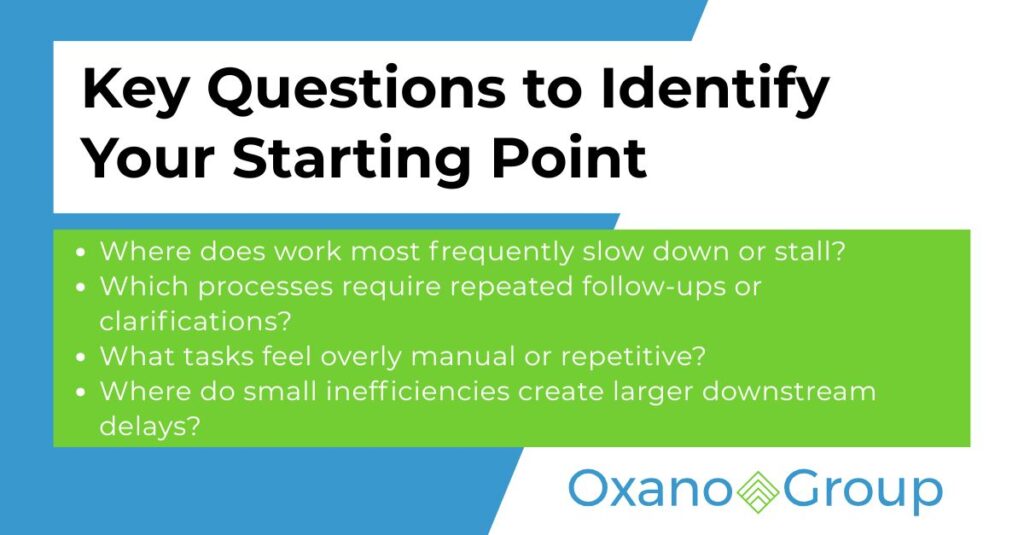
Every organization has a small number of workflows that carry disproportionate importance. These are often tied to customer experience, revenue generation, or internal coordination that impacts multiple teams. They are also the areas where delays, rework, or ambiguity tend to surface most clearly.
Focusing on these workflows first creates immediate clarity and momentum. Rather than attempting to improve everything at once, narrowing attention to a few critical flows allows teams to see tangible progress and build confidence in a new way of operating.
Designing Workflows That Move with Clarity
Once a priority workflow is identified, the next step is to redesign it with simplicity in mind. This is not about incremental improvement, it’s about removing friction and creating a clean, intentional flow of work.
A practical way to approach this is through four actions:
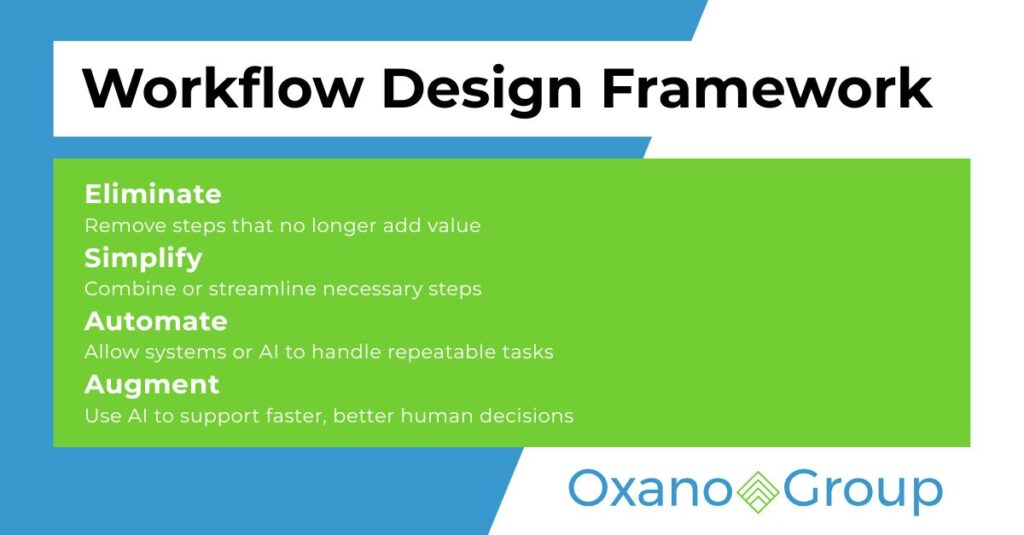
When applied thoughtfully, this approach reduces complexity without sacrificing quality. In many cases, it reveals that what once required multiple handoffs can be completed by a single accountable owner, supported by the right tools.
Aligning Roles in an AI-Enabled Environment
As workflows become more streamlined, roles naturally evolve alongside them. This is not about reducing the importance of people, it is about allowing individuals to focus on the work where they create the most value. And value creation positively impacts culture in any environment.
A helpful way to think about this shift is to distinguish between three types of work. Some activities remain deeply human, requiring judgment, relationship-building, and leadership. Others benefit from AI assistance, where speed and clarity can be enhanced without removing human oversight. Still others can be fully automated, particularly when they are repetitive and rules-based.
When these distinctions are made clear, teams operate with greater focus. Individuals spend less time navigating process and more time contributing meaningfully to outcomes. AI becomes a support system within a well-defined structure, rather than a disruptive force layered on top.
AI That Reflects Who You Are
There is a deeper layer to this conversation that often gets overlooked. As organizations adopt AI, the question is not only how work becomes faster or more efficient. It is whether the way that work is done continues to reflect what the organization stands for.
Every company operates from a set of beliefs, whether formally defined or not. Mission defines why the organization exists. Vision points to where it is going. Values shape how decisions are made along the way. These are not abstract ideas – they are the standards that guide behavior, prioritization, and ultimately, outcomes.
AI will participate in that system. The way it is implemented will influence how decisions are made, how customers are engaged, and how teams experience their work. Without intentional alignment, organizations risk introducing speed and scale that unintentionally drift from their identity.
With alignment, something very different happens. AI becomes an extension of the organization’s principles. It reinforces how decisions are made, supports the kind of customer experience the company is known for, and helps teams operate in a way that is consistent with the culture they are building.
This is where discipline matters. Before implementing AI within a workflow, it is worth asking a different set of questions:
- Does this change or reinforce how we want to show up for our customers?
- Does it support the level of quality and care we expect in our work?
- Does it enable our team to operate in a way that reflects our values?
When these questions guide implementation, AI does more than improve efficiency, it strengthens the integrity of the organization as it scales.
Building a Secure and Accountable AI Strategy
From a VCIO or Director of IT perspective, successful AI adoption is not about chasing tools. Instead, it’s about creating a secure, practical, and accountable way to enhance business operations. The true opportunity arises when leaders identify areas where AI can streamline manual tasks, accelerate processes, and support more informed decision making. At the same time, they must implement robust guardrails to safeguard data, ensure access controls, and maintain oversight.
Organizations that excel in this approach are not merely experimenting with AI; they are constructing a more robust operating model that is scalable, governed effectively, and aligned with business objectives.
Creating Momentum Through a Consistent Rhythm
Sustainable progress does not require large-scale transformation initiatives. It is built through consistent attention, iteration, and alignment with the principles that guide the organization – its Mission, Vision, and Values.
These are not static statements. They act as a filter for how work is designed, how decisions are made, and how new capabilities like AI are introduced into the business.
Establishing a simple operating rhythm allows teams to continuously refine how work gets done. At the team level, this means regularly reflecting on what slowed progress and where improvements can be made. At the leadership level, it involves stepping back to assess which changes are delivering value and where to focus next.
This rhythm creates a compounding effect. Small improvements, implemented consistently, lead to meaningful gains over time. As confidence grows, so does the organization’s ability to take on more ambitious redesigns.
Building Confidence and Adoption
Adoption of new ways of working is strongest when it is grounded in clarity and shared purpose. Teams respond well when they can see how changes make their work more effective and less burdensome.
Starting with visible, practical improvements helps build that confidence. When individuals experience firsthand how a redesigned workflow or AI-assisted step saves time or reduces frustration, momentum follows naturally. Open dialogue, feedback, and iteration further strengthen this process, ensuring that improvements are both effective and sustainable.
What This Unlocks
When workflows are intentionally designed and roles are clearly aligned, AI becomes a true multiplier. Work progresses with fewer interruptions, decisions are made more efficiently, and teams can focus on the areas where they have the greatest impact.
Over time, this creates a system that not only performs better but continues to improve. Each refinement builds on the last, resulting in an operating model that is both scalable and resilient.
Moving Forward
The path forward does not require sweeping change. It begins with a single workflow, thoughtfully examined and redesigned. From there, progress builds step by step.
Organizations that take this approach position themselves to move with clarity and confidence, making the most of what AI enables without losing sight of what matters most: how work gets done, and how people contribute to it.
Final Thought
AI offers a powerful opportunity, but its true value is not found in the technology itself. It is found in how thoughtfully it is integrated into the way an organization operates, and how consistently that integration reflects what the organization stands for.
When work is clear, teams are aligned, and decisions are guided by a strong Mission, Vision, and Values, AI becomes more than a tool. It becomes a natural extension of how the business thinks, operates, and grows.
That is what allows organizations to scale without losing what made them effective in the first place. And that is where lasting advantage is built.